2026 breed risk report: Pets most at risk for ER and specialty care
More than a third of American pet owners (37%) never chose their pet by breed. They simply adopted or inherited the animal that came into their life. Veritas Veterinary Partners surveyed 1,055 dog and cat owners to find out what happens next. We wanted to know how well owners understand the health risks inherent in their pet's breed, which pets most often end up in the emergency room, and how often a single ER visit requires a specialist.
What we found was a wide gap between how confident owners feel and how prepared they actually are.
Key takeaways
- Australian Shepherds/Border Collies, Chihuahuas, and Yorkies are the dog breeds most likely to need emergency care.
- Flat-faced dog owners were the most confident of any group about their pet's risks (30% not confident, against 48% overall), yet flat-faced pets' ER visits required a specialist 54% of the time versus 39% for other pets.
- Ragdolls (73%) and Siamese (65%) are the cats most likely to have landed in the ER.
- 2 in 5 pet ER visits (41%) require escalation to a specialist.
- One of America's favorite dogs is also among the most likely to need referral to a specialist: 53% of Golden Retriever ER visits escalated, according to their owners.
- Nearly half of American pet owners (48%) can't name their pet's biggest breed-related health risk.
- 42% of pet owners couldn't cover a $1,000 pet emergency without going into debt.
- 54% of American pet owners have neither pet insurance nor dedicated emergency savings; mixed-breed cat owners are the most likely to have neither (62%).
What owners don't know about their own pet's risks
Before an emergency ever happens, most owners are already working with incomplete information about their pet's breed.
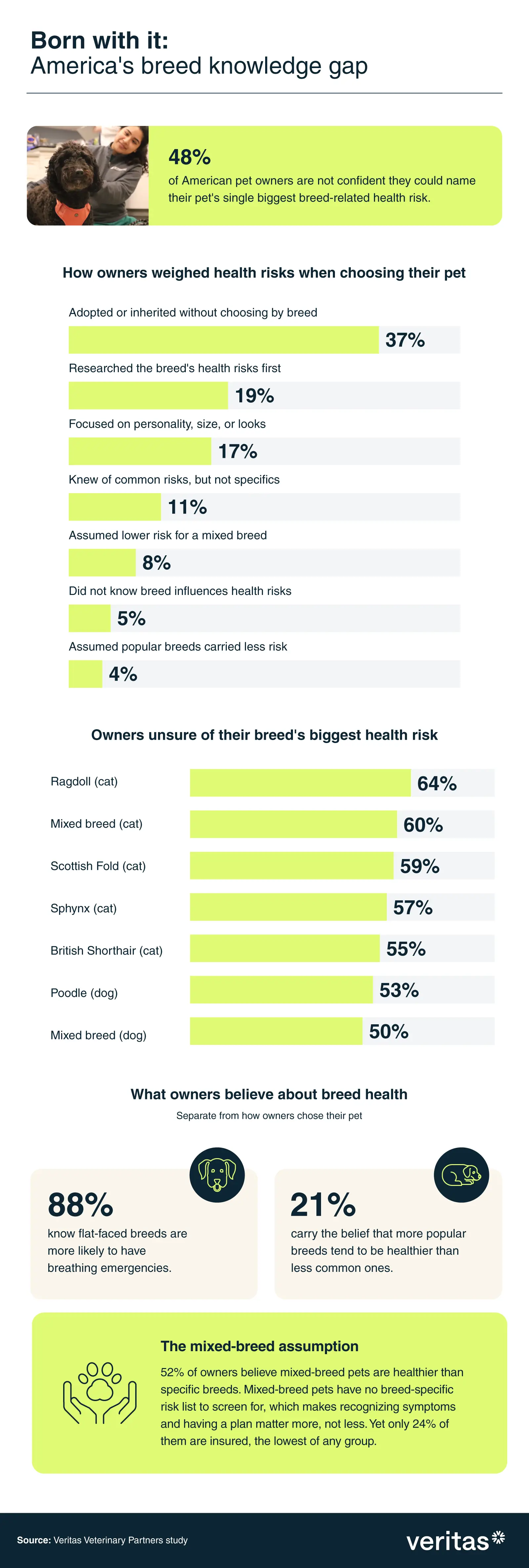
Nearly half of owners (48%) couldn't confidently name their pet's single biggest breed-related health risk. Only 18% said they were very confident, while 34% were somewhat confident, 29% not very, and 19% not at all. That includes owners of mixed-breed pets, who were less confident than owners of a specific breed (58% versus 43%). This tracks with how pets arrive in the first place: 37% of owners adopted or inherited their pet without choosing by breed, and just 19% researched a breed's health risks before bringing one home.
Some knowledge has clearly gotten through. A full 88% of owners knew flat-faced breeds are more likely to have breathing emergencies. Other beliefs were shakier. About half of owners (52%) believed mixed-breed pets are healthier than specific breeds, a belief that climbed from 43% of Gen Z to 65% of baby boomers. We also asked whether a breed's built-in health risks are mostly out of an owner's control, and 42% said they are. In practice they aren't. Weight management, breed-specific screening, and knowing which symptoms warrant an ER visit all change how a predisposition plays out.
Cat owners carried the biggest blind spots. Five of the seven least-confident owner groups were cat groups, led by Ragdoll owners (64%) and mixed-breed cat owners (60%). Mixed-breed cats here include Domestic Shorthairs and Domestic Longhairs, the standard terms for cats without a specific documented breed, alongside owners who described their cat as a mix. Overall, cat owners trailed dog owners in confidence (56% not confident vs. 40%).
Mixed-breed dog and cat owners were among the least confident of any group at 58%. And first-time owners were more sure of themselves than longtime owners (40% not confident vs. 50% not confident, respectively).
There is a grain of truth in the healthier mixed-breed belief. The Dog Aging Project found that being a single specific breed, rather than a mix, is among the factors that raise bloat risk. But lower risk on one condition is not lower risk overall. Mixed dogs still account for 6% to 16% of bloat cases, and 52% of mixed-breed pet owners said their pet has already needed emergency care.
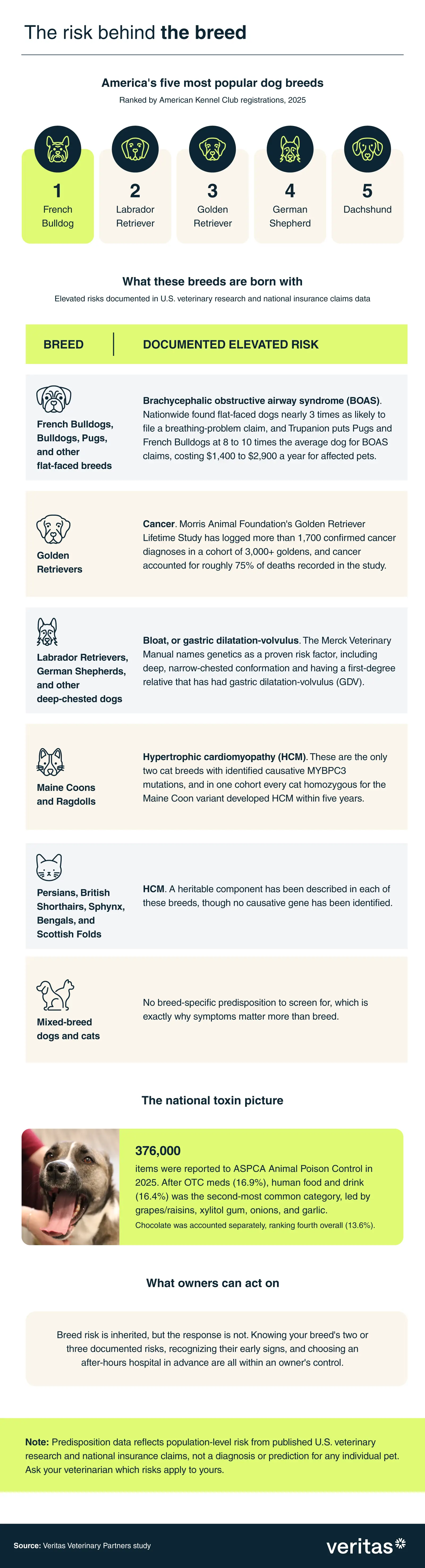
The American Kennel Club (AKC) ranks the French Bulldog as America's most popular dog breed for the fourth year running, followed by the Labrador Retriever, Golden Retriever, German Shepherd, and Dachshund. Owners may not know what those breeds are predisposed to, but veterinary research does.
Nationwide's analysis of more than 50,000 brachycephalic dogs found flat-faced dogs nearly three times as likely to file a breathing-problem claim, and Trupanion puts Pugs and French Bulldogs at eight to ten times the average dog for Brachycephalic Obstructive Airway Syndrome (BOAS) claims, with costs of $1,400 to $2,900 a year for affected pets.
The Golden Retriever Lifetime Study has logged more than 1,700 confirmed cancer diagnoses among its 3,000-plus goldens, with cancer accounting for roughly 75% of deaths recorded. The Merck Veterinary Manual lists German Shepherds and Standard Poodles among the breeds most frequently affected by bloat, alongside Great Danes and Saint Bernards, with mortality running 20% to 45% even in treated dogs, and the American College of Veterinary Surgeons (ACVS) notes that preventive gastropexy can be performed during a spay or neuter for at-risk breeds.
On the cat side, Maine Coons and Ragdolls are the only two breeds with identified causative MYBPC3 mutations for hypertrophic cardiomyopathy (HCM), though a heritable component has been described in Persians, British Shorthairs, Sphynx, Bengals, and Scottish Folds.
The breeds that land in the ER most often
Emergency care wasn't a rare event for the pets in our study.
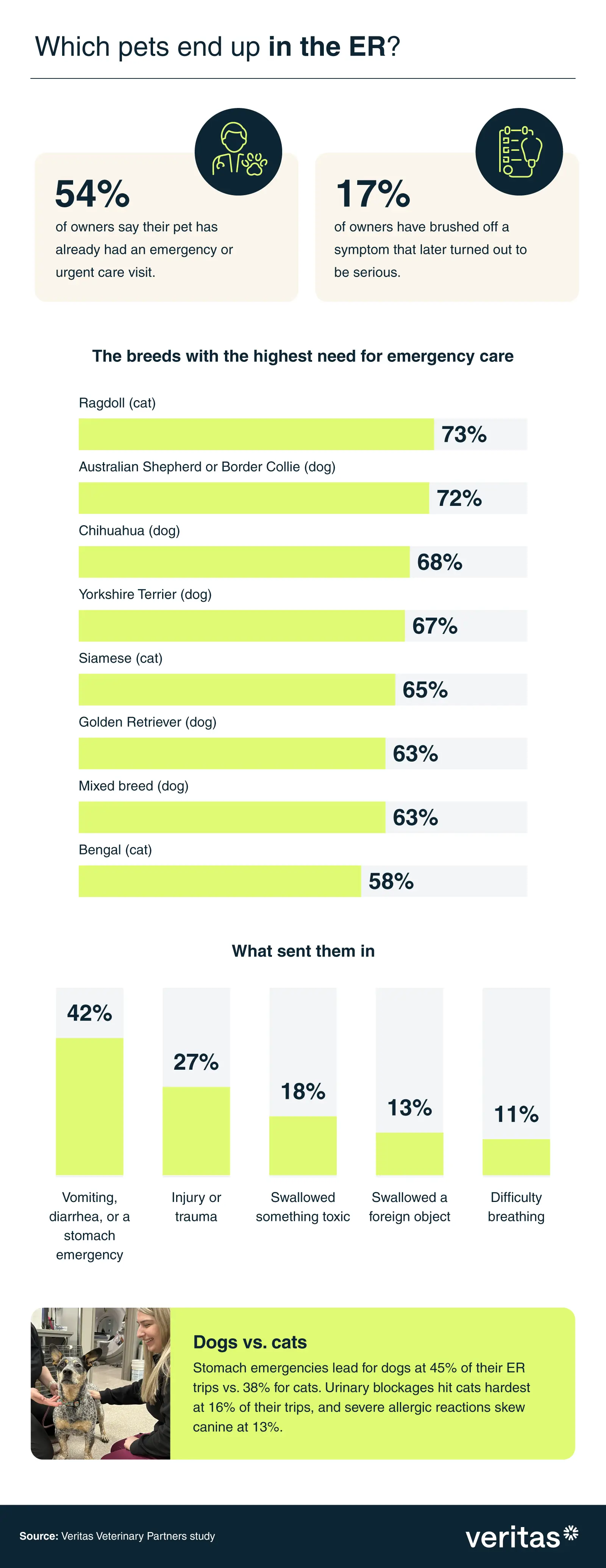
Over half of owners (54%) said their pet has already had an emergency or urgent care visit. Dogs outpaced cats overall at 58% versus 50%. Vomiting, diarrhea, or another stomach emergency was the leading cause at 42% of those trips, followed by injury or trauma (27%), toxic ingestion (18%), swallowed foreign objects (13%), and difficulty breathing and urinary blockages (11% each).
The rates varied widely by breed, per their owners. Ragdolls topped the list, with 73% needing emergency care, followed by Australian Shepherds or Border Collies (72%), Chihuahuas (68%), Yorkies (67%), and Siamese (65%). The type of emergency is split by species, too. Stomach emergencies accounted for 45% of dogs' ER visits, compared to 38% for cats. Urinary blockages hit cats hardest at 16%, and severe allergic reactions skewed canine at 13%. Among mixed-breed cats that reached the ER, urinary blockages and toxic ingestion each drove 16% of owner-reported visits, while toxic ingestion drove 27% of mixed-breed dogs' trips.
Age and generation also affected the numbers. Senior pets had an owner-reported emergency rate of 59%, compared with 42% for puppies and kittens. Furthermore, senior dogs (67%) reported a significantly higher emergency rate than senior cats (50%). Millennial owners reported the highest ER rate at 60%, and baby boomers the lowest at 45%.
Meanwhile, 17% of owners reported brushing off a symptom that later turned serious. Younger owners were the most likely to do so, with Gen Z and millennials at 19% each and baby boomers at 11%. Mixed-breed dog owners were the most likely of any breed group to do so, at 27%.
The hazards owners worry about most and feel least ready for
Seasonal dangers loomed large for owners, though preparation didn't always match the worry.
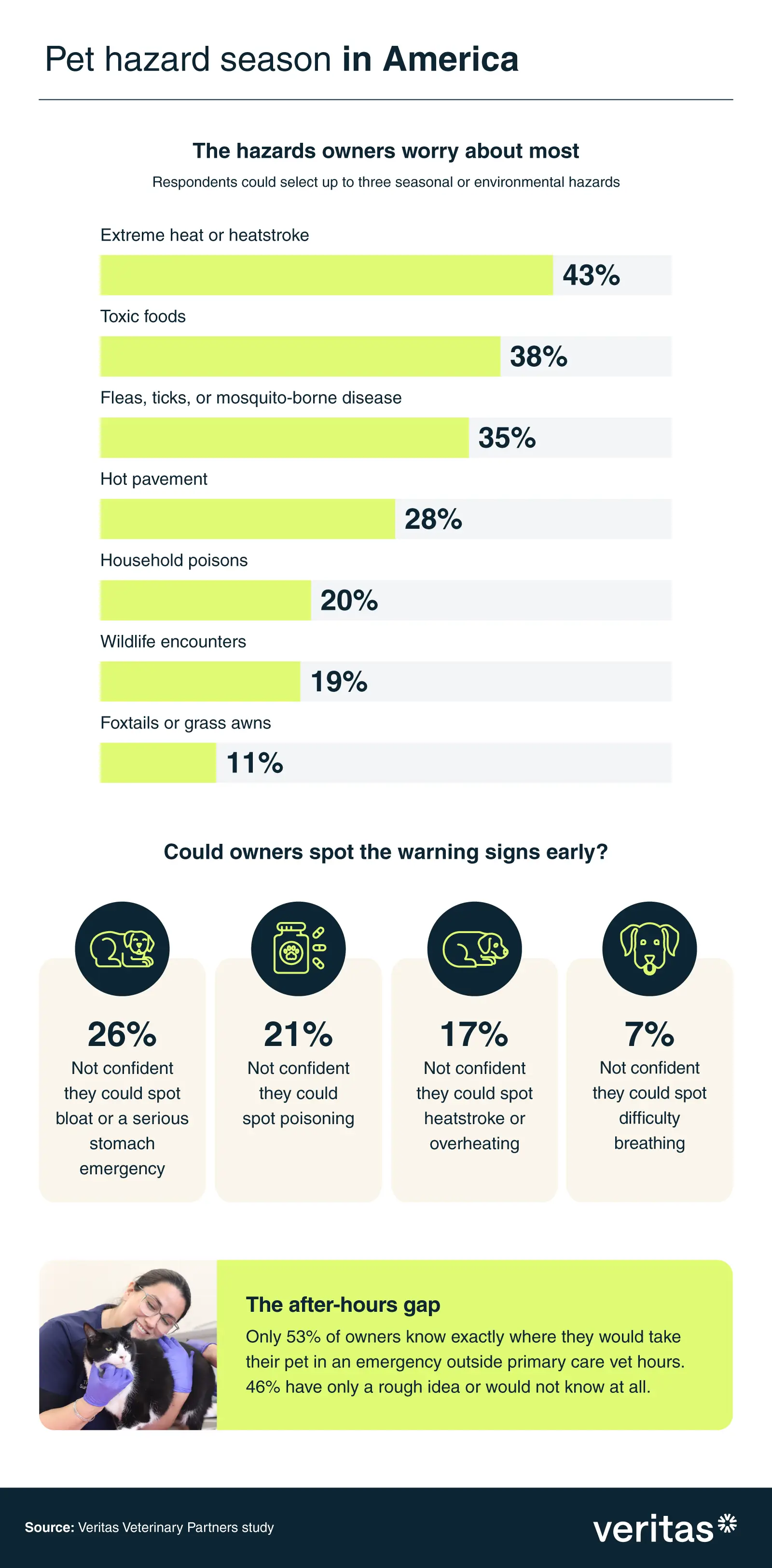
Extreme heat topped the worry list at 43%, ahead of toxic foods (38%), fleas, ticks, or mosquito-borne diseases (35%), and hot pavement (28%). The same hazards also led the least-prepared list, with heat and fleas/ticks at 12% each and toxic foods at 10%.
ASPCA Poison Control fielded reports on more than 376,000 exposures in 2025. Human food and drink ranked second at 16.4%, led by grapes and raisins, xylitol gum, and onions and garlic, with chocolate fourth (13.6%). Owners' worry about toxic foods is well placed.
Recognizing symptoms was a weak point for some people. A quarter of owners (26%) weren't confident they could spot bloat early, 21% said the same about poisoning, and 17% about heatstroke. Just over half (53%) knew exactly where they'd take their pet in an after-hours emergency, while 39% had a rough idea and 7% wouldn't know where to go.
When one ER visit needs a specialist
For many pets, the emergency room was only the first stop.
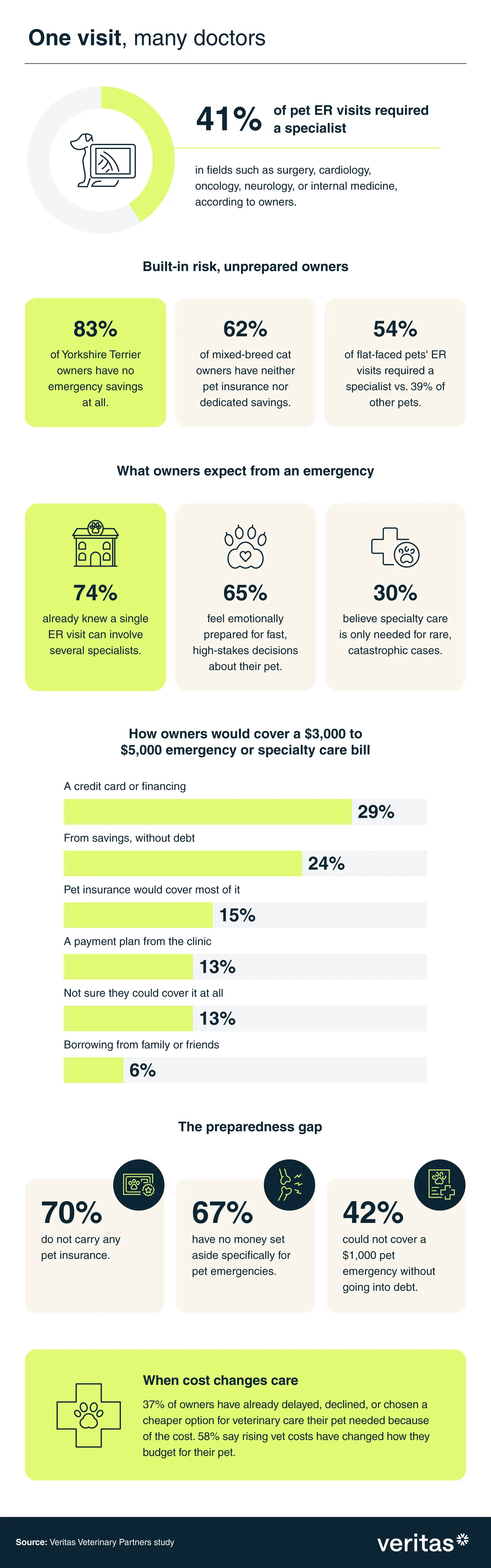
Among owners whose pet has been to the ER, two in five (41%) said the visit required a specialist, in fields such as surgery, cardiology, oncology, neurology, or internal medicine. Most owners (74%) already knew a single ER visit can involve several specialists, though 30% still believed specialty care is only for rare catastrophes. 80% of owners whose pet had been to the ER already knew a visit can involve several specialists, versus 68% of owners whose pet hadn't.
About two-thirds (65%) felt emotionally prepared for a serious emergency, and 58% said rising costs had already changed their pet budget. Escalation followed breed lines, too. Flat-faced pets' ER visits moved into specialty care at 54%, far above the 39% for other pets, and Maine Coons (58%), Siamese (55%), and Golden Retrievers (53%) posted the highest breed-level escalation rates. Specific-breed cats' owner-reported ER visits escalated more often (48%) than those for mixed-breed cats (39%).
The finances were the sobering part. More than 2 in 5 owners (42%) couldn't cover a $1,000 pet emergency without going into debt. Two-thirds of owners (67%) had no money set aside for pet emergencies. Some of them did carry pet insurance, which leaves 54% with neither a cushion nor a policy.
Advanced cases require advanced care, and that carries higher costs. A hospital staffed around the clock with board-certified specialists is a different operation from a primary care practice, with different equipment, staffing, and overnight capability. Take one of the most common stomach emergencies. Surgery to clear an intestinal blockage in a dog averages $4,383 nationally and runs as high as $7,976 depending on the state, according to CareCredit, drawing on a 2025 Synchrony procedural cost study. For cats, foreign body removal averages $2,367 and reaches $4,303. Those are national cost-research figures, not pricing at any Veritas hospital.
That's why we asked owners how they would pay a bill of that size. Faced with a $3,000 to $5,000 bill for emergency or specialty care, 29% would reach for a credit card, 24% for savings, and 15% for pet insurance, while 13% weren't sure they could cover it. Money had already changed care for many, with 37% having delayed, declined, or downgraded treatment over cost.
Mixed-breed pets were the least protected group: only 24% of mixed-breed pets were insured, and 62% of mixed-breed cat owners had neither insurance nor savings. Yorkies (12%), Pit Bull-types (17%), and Labs (18%) were the least insured named breeds, and 83% of Yorkie owners had no emergency savings. German Shepherd (53%) and Golden Retriever owners (52%) were the best protected. The share with neither insurance nor savings increased with age, from 42% among Gen Z to 77% among baby boomers.
Our findings track national patterns. The ASPCA reported this year that roughly six in 10 U.S. pet owners lack confidence that they could afford a pet's medical emergency, and a PetSmart Charities-Gallup study found that 52% of U.S. pet owners skipped needed veterinary care in the past year.
Preparing for the visit you can't schedule
No owner can put an emergency on the calendar, but the data suggests that most can better prepare for one. Learning your pet's top breed-related risks, knowing the early signs of conditions like bloat and heatstroke, and deciding in advance where you'd go after hours can save precious time. Even a modest cushion of savings, or an insurance policy, can keep a medical decision from doubling as a financial one.
Methodology
To explore how well American pet owners understand their pets' breed-related health risks and how prepared they are for veterinary emergencies, we surveyed 1,055 dog and cat owners across the country via online survey panels from June 22 to July 14, 2026. The sample spanned four regions, with 43% of respondents in California, 19% in Nevada, 19% in Colorado, and 19% in New York and New Jersey. It also included concentrated metro samples in Orange County (14%), Marin County (11%), Las Vegas (10%), Staten Island and nearby New Jersey (10%), and the Denver and Wheat Ridge area (9%). These regions reflect the markets served by Veritas Veterinary Partners hospitals.
Respondents who owned more than one pet were asked to answer about the single pet they would be most worried about in a medical emergency. Among respondents, 51% answered about a dog and 49% about a cat; 56% were women, 43% were men, and 1% were non-binary. All respondents were adults ages 18 and older. By generation, 20% were Gen Z (ages 18 to 29), 45% were millennials (ages 30 to 45), 29% were Gen X (ages 46 to 61), and 6% were baby boomers (ages 62 and older).
Questions about the causes of emergency visits and the escalation into specialty care were asked only of the 572 respondents whose pet had experienced an emergency or urgent-care visit. All other questions, including those about owner expectations of emergency care, were asked of all 1,055 respondents. Percentages for multi-select questions are based on all respondents shown the question and may total more than 100. All figures are rounded to the nearest whole percentage, so some totals may not equal 100.
This report also draws on published U.S. data. Breed commonality reflects American Kennel Club 2025 registration statistics. Breed predisposition figures come from Nationwide's analysis of more than 50,000 brachycephalic dogs; Trupanion claims data; Morris Animal Foundation's Golden Retriever Lifetime Study, an ongoing cohort of more than 3,000 dogs; the Merck Veterinary Manual; the American College of Veterinary Surgeons; the Dog Aging Project's analysis of 47,444 dogs; and published research on feline HCM genetics. Seasonal and toxin figures come from ASPCA Poison Control's 2025 exposure data.
Emergency surgery costs come from CareCredit's published averages, based on a 2025 Synchrony Average Procedural Cost Study conducted by ASQ360° Market Research, and are not pricing at Veritas hospitals.
Breed categories reflect what owners reported. "Specific-breed" means the owner identified a single breed rather than a mix; it does not imply registry documentation.
Affordability comparisons come from a 2026 ASPCA survey and the PetSmart Charities-Gallup State of Pet Care study. Predisposition data describes population-level risk, not a diagnosis or prediction for any individual pet.
About Veritas Veterinary Partners
Veritas Veterinary Partners is a national network of leading specialty and emergency veterinary care hospitals. Built around the principles of truth and trust, Veritas is a mission- and values-driven entity with a network of like-minded partners. By offering extensive resources and access to a national network of leading providers, Veritas enhances growth, recruitment, professional development, and internal culture for its employees. For more information on partnership and career opportunities, please visit www.veritasvetpartners.com.
Fair use statement
This content is free to use for noncommercial purposes. We just ask that you credit Veritas Veterinary Partners and link back to us when sharing.