How Veterinary Specialists Compare With Human Medicine
A dog or cat can see a board-certified heart, cancer, brain, or eye specialist, the same kinds of specialists people rely on. Veterinary medicine is organized into specialties that mirror those in human medicine.
Veritas Veterinary Partners compared the veterinary and human medical specialty systems using official registries. Our analysis found that the two systems share many of the same board-certified specialties. Published data also shows pets can get many of the same advanced treatments people do.
Key takeaways
- Pets can see the same kinds of specialists people can: 25 veterinary specialties have a matching board in human medicine, including heart, cancer, brain and eye care.
- There is about one board-certified veterinary cardiologist for every 330,000 owned U.S. dogs and cats. In human medicine, there is about one for every 11,000 people.
- Pets can get hip replacements, pacemakers, and cataract surgery. Cataract surgery works 80% to 90% of the time in good candidates, compared with about 98% in people. Options depend on the pet and the hospital.
- Human medicine has specialties for different life stages, such as pediatrics. Veterinary medicine has specialties for different kinds of animals, such as birds and horses, which make up nearly half of its unique boards.
- One dose of radioactive iodine cures about 95% of cats with an overactive thyroid. Most need no daily medicine afterward.
- Veterinary emergency and critical care has 1,092 board-certified specialists, about one for every 150,000 owned dogs and cats.
The specialties veterinary and human medicine share
Veterinary and human medicine divide the body into many of the same specialties.
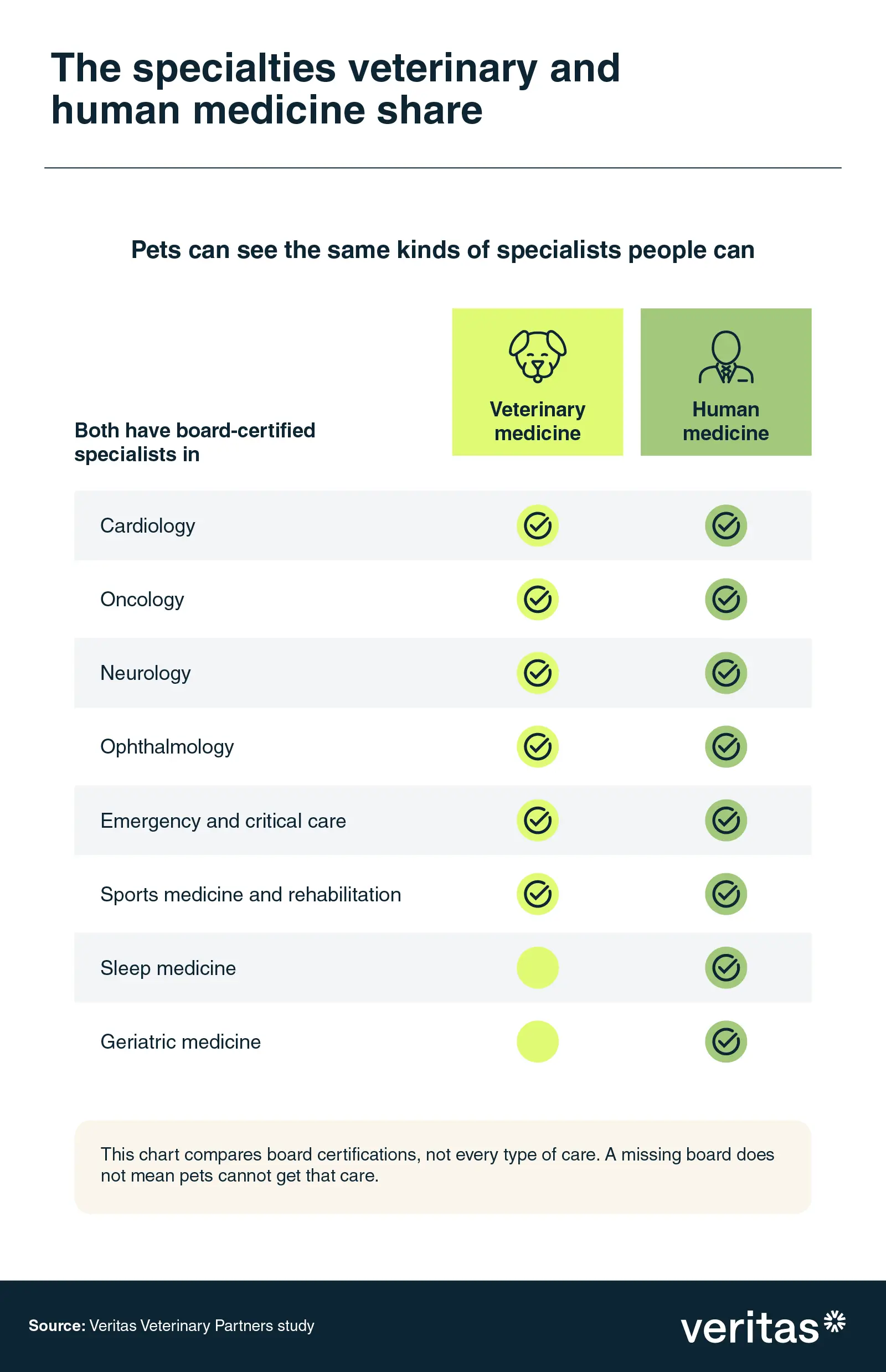
Pets can see the same kinds of specialists people can. Twenty-five veterinary specialties have a matching board in human medicine, from cardiology and oncology to neurology and ophthalmology, alongside dermatology, emergency and critical care, anesthesia, surgery and radiology. Beyond those, veterinary medicine has 26 board-certified specialties of its own, and human medicine has about 124.
The two systems also differ in how they’re organized. Human medicine has specialties for different life stages, such as pediatrics, while veterinary medicine has them for different kinds of animals. Nearly half of the veterinary-only boards cover a specific type of animal, from poultry and horses to reptiles and fish.
Advanced treatments available to pets
Many advanced procedures used in human medicine are also available for pets.
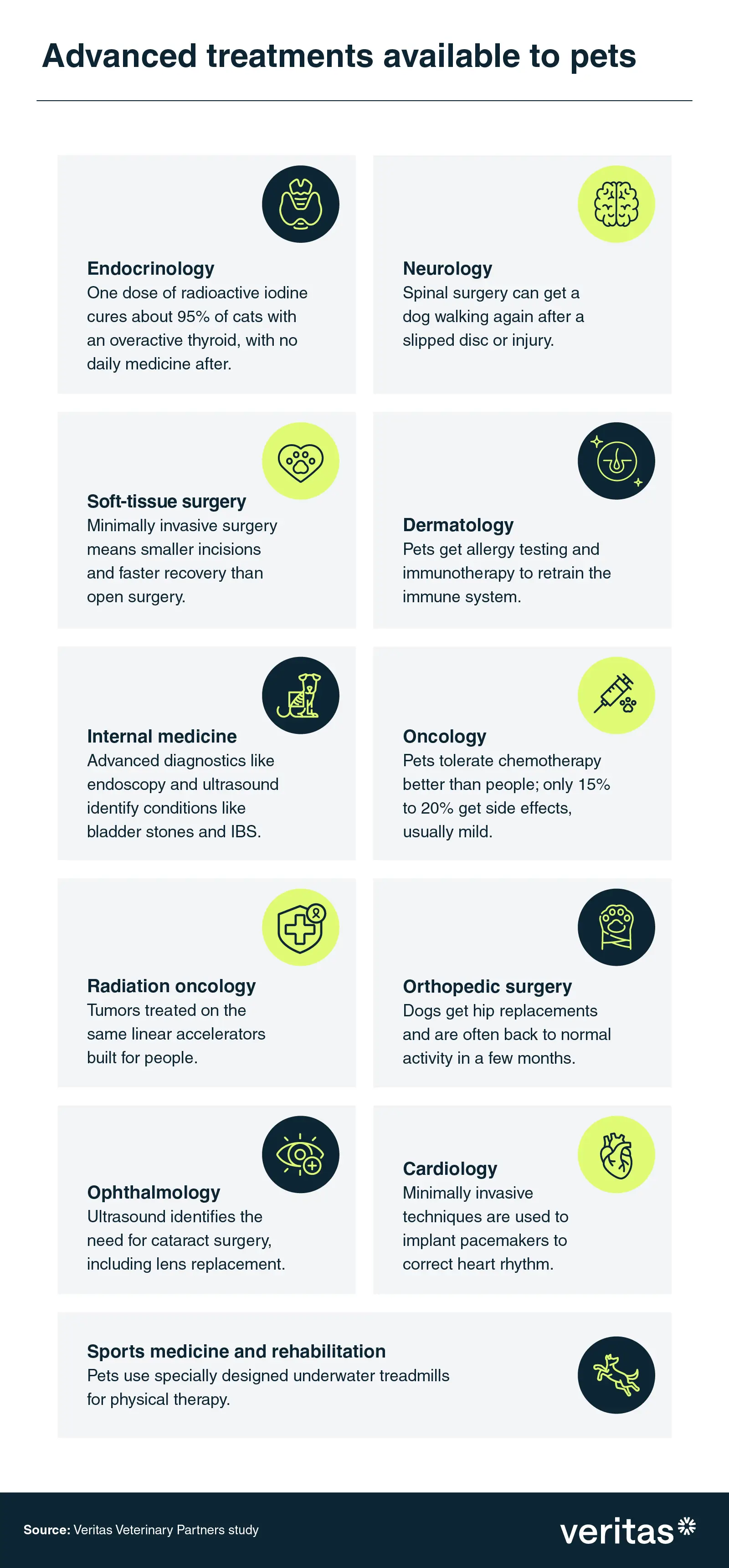
One dose of radioactive iodine cures about 95% of cats with an overactive thyroid, and most need no daily medicine afterward. In people, the same treatment usually destroys the thyroid gland, so most then take a daily thyroid pill for life. Dogs received hip replacements built on the same ball-and-socket design people get, placed by board-certified veterinary surgeons, and most went home within one to three days and returned to normal activity in about four months. Cataract surgery, the same operation people get, succeeded 80% to 90% of the time in good candidates.hen dogs needed chemotherapy, only 15% to 20%
Other advanced care mirrored human medicine closely. Medtronic donated hundreds of pacemakers a year for pets through the CanPacers registry, and veterinary cardiologists implanted them in dogs. When dogs needed chemotherapy, they tended to tolerate it better than people do, with only about 15% to 20% developing noticeable side effects, which were usually mild. These published figures vary by patient, and not every hospital offers every treatment.
How thinly veterinary specialists are spread
Sharing a specialty does not mean sharing the same number of specialists.

There was about one board-certified veterinary cardiologist for every 330,000 owned U.S. dogs and cats, against about one for every 11,000 people in human medicine. The American Veterinary Medical Association (AVMA) reported 497 veterinary cardiologists in all. Among the eight clinical fields we charted, the gap was widest in anesthesia, internal medicine, and cardiology, where people had about 65, 56, and 30 times as many specialists.
Even emergency and critical care, with more than twice as many specialists as cardiology, worked out to about one of its 1,092 board-certified specialists for every 150,000 owned dogs and cats. Radiation oncology had 164 board-certified veterinary specialists, or about one for every million owned dogs and cats. Vet radiation oncologists use the same cancer radiation machines (linear accelerators) used to treat people. These figures compare specialist counts with population size. They do not measure how easy it is to get an appointment or how many patients each specialist sees, and the veterinary counts are rough upper estimates.
Quick facts
- How many veterinary specialists are there? The AVMA reports more than 16,500 board-certified vets holding 20,636 certifications.
- How many veterinary specialties are there? The AVMA recognizes 48 across 22 specialty colleges.
- How many veterinary cardiologists are there? There are 497 board-certified veterinary cardiologists in the U.S.
What this means for your pet
Pets may have more care options than their owners realize. Many specialty fields match those in human medicine, and so does much of the technology. Veterinary specialists work with primary care vets, not in place of them. Knowing these options exist can help you ask the right questions when a pet needs more than routine care.
Methodology
This study compares how veterinary and human medicine organize their specialists in the United States. It uses official registries, assembled on October 6, 2026.
Veterinary data comes from the American Veterinary Medical Association, with counts as of December 31, 2025. The AVMA recognizes 48 specialties across 22 colleges. Counting each specialty track on its own gives 51, which is the number the our comparison uses. Human data comes from the ABMS 2025 to 2026 report across 24 member boards, as of June 30, 2026. Human only means no veterinary board. Veterinary only means no human-medicine (ABMS) board, since some fields have credentials outside the ABMS system.
Density is board-certified specialists per population, not a measured caseload. Pets are the 164 million owned U.S. dogs and cats in the AVMA 2025 pet ownership statistics, which come from an opt-in online survey of 7,519 households. People are the 342 million U.S. residents in the Census Bureau 2025 estimates. Ratios are rounded, so we describe the gaps as approximate.
A specialty is shared when a human-medicine board covers the same organ or function.”. Fields with no single patient population, like lab animal medicine, are left out of the density comparison, as are fields with no published count.
Veterinary counts may include specialists outside the U.S. and may count multiple certifications held by the same person. These factors can increase the estimated veterinary specialist density. The comparison also uses different reporting dates and population definitions. So the ratios are approximate structural comparisons, not measures of care availability. Pediatric certificates are measured against the full population because no child-only figure was available.
Treatment facts in the second section come from these sources:
- Feline thyroid cure rate, from the University of Illinois and Penn Vet. Human outcome after radioiodine, from the American Thyroid Association and a clinical review.
- Canine chemotherapy side effects, from the UC Davis veterinary hospital and the American Kennel Club.
- Hip replacement, from the University of Missouri and NC State veterinary hospitals.
- Pacemaker donations, from Medtronic.
- Cataract surgery outcomes, from Cornell University and Veterinary Ophthalmology, the journal of the American College of Veterinary Ophthalmologists.
About Veritas Veterinary Partners
Veritas Veterinary Partners is a national network of leading specialty and emergency veterinary care hospitals. Built around the principles of truth and trust, Veritas is a mission- and values-driven entity with a network of like-minded partners. By offering extensive resources and access to a national network of leading providers, Veritas enhances growth, recruitment, professional development, and internal culture for its employees. For more information on partnership and career opportunities, please visit www.veritasvetpartners.com.
Fair use statement
This content is free to use for noncommercial purposes. We just ask that you credit Veritas Veterinary Partners and link back to us when sharing.