The Pet Hazard Map: Where, When & What Puts Pets at Risk
A pet's biggest dangers aren't the same in Phoenix as in Pittsburgh, and they aren't the same in July as in January. Veritas Veterinary Partners set out to map where and when pets face the most risk, and how well owners actually recognize it. We did this across three sets of research, including a state-by-state index of outdoor hazards, an audit of the country's bestselling pet foods, and a survey of 1,006 U.S. cat and dog owners.
Key takeaways
- California, Texas, and Arizona are the most hazardous states for pets outdoors, and every state in the top four sits in the South or Southwest, where warm climates support the widest range of venomous animals and toxic plants.
- On top of the toxic plants that threaten pets year-round, all five seasonal hazards are still active at once as late as September, with rattlesnakes near their peak just as toxic mushrooms surge toward their October high..
- Nearly 7 in 10 pet food recalls are driven by dangerous bacteria, with Salmonella being the leading cause of recalls (47%).
- The average pet owner scored just 82% on a basic pet-hazard quiz, getting nearly 1 in 5 questions wrong.
- Pet owners over-flag harmless plants yet miss genuine poisons: 71% think rose bushes are toxic, but 1 in 4 don't know macadamia nuts are dangerous.
- When a pet eats something toxic, most owners turn to Google before their vet, and more than half don't know pet poison hotlines exist.
The South and Southwest are often the riskiest ground for pets
The states where pets face the most outdoor danger cluster in warm climates that support the widest range of venomous animals and toxic plants.
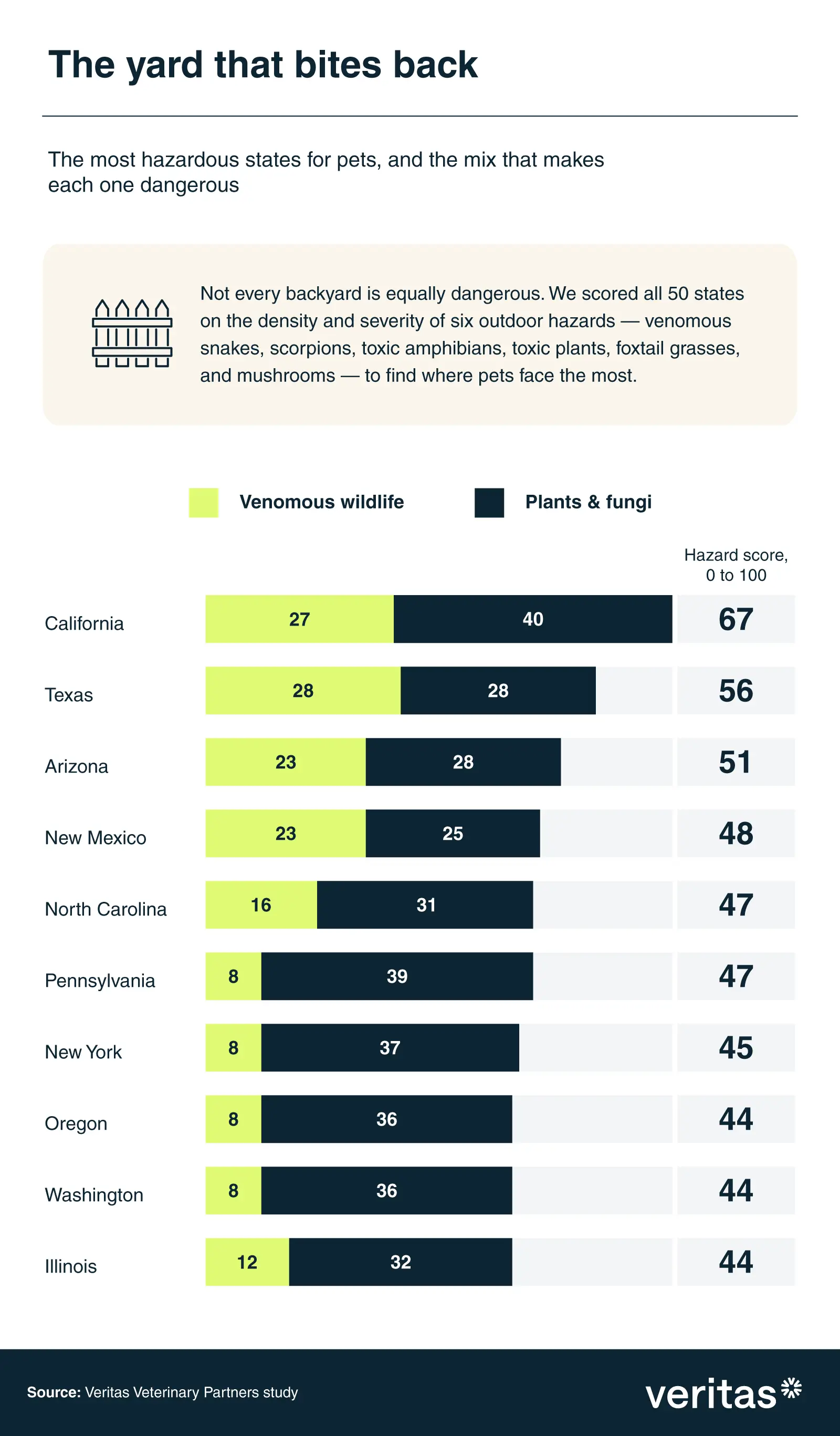
California, Texas, and Arizona ranked as the three most hazardous states, followed by New Mexico and North Carolina, and the top of the list clusters in the South and Southwest. The chart splits each state's score into venomous wildlife and toxic plants and fungi, and in most of the top states, plants and fungi carry the larger share of the risk.
No region escaped entirely. Toxic toads and foxtail grass showed up in all 50 states, and even the lowest-ranked states carried real risks. Vermont, near the bottom of the list, still had 32 confirmed toxic plants and a timber rattlesnake.
Late summer into fall stacks the most hazards at once
Outdoor hazards don't peak on the same schedule, and the overlap is what makes the warm months so risky.
The riskiest stretch runs from late summer into early fall. Toxic plants threaten pets year-round, and the five seasonal hazards pile on top of them. As late as September, all five are still active at once, with rattlesnakes near their peak just as toxic mushroom season climbs toward its October high.
In the Southwest, that peak tracks the summer monsoon, when heat and rain bring out snakes, scorpions, and toads together. Because the mix and timing shift sharply from one state to the next, we built an interactive map around your own state and season. One rule holds all year, though: a suspected rattlesnake or coral snake bite is a same-night emergency, whatever the season.
The next hazard is waiting in the food bowl
The dangers don't stop at the back door. Some of the most common ones are inside the house, in the food bowl itself.

Price, more than anything, predicted what was in the bowl. Artificial dyes appeared in 92% of budget best-selling foods, but in none of the 26 premium best-sellers we checked. Every flagged additive we found is legal in U.S. pet food, yet each one is restricted, being phased out, or flagged for review by a safety agency here or abroad.
Some of those rules only go so far. Propylene glycol, for example, is banned from cat food because it can damage feline red blood cells, yet it remains legal in dog food, where it still turns up in budget brands.
Pet owners feel sure, but often get it wrong
Spotting these hazards is harder than it sounds, and the survey showed how often owners misread the everyday ones.
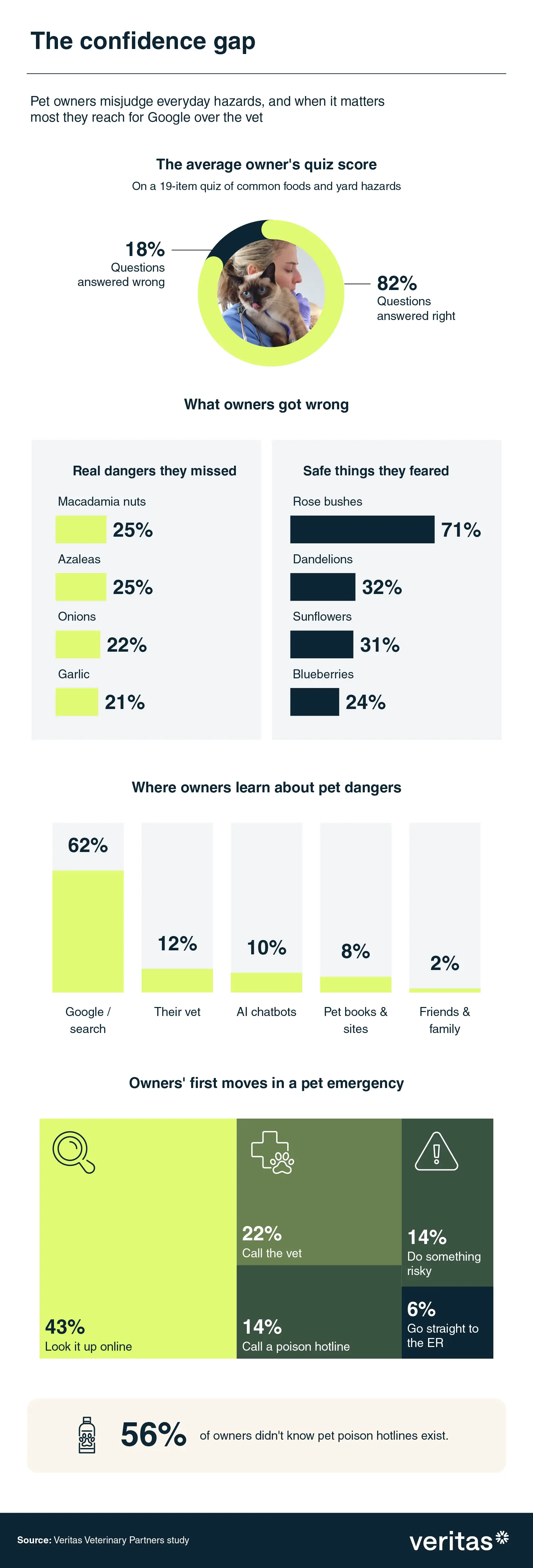
On a 19-item quiz on common foods and yard items, the average owner scored just 82%, missing nearly one in five questions. The mistakes ran both ways. Owners were quick to fear harmless things, with 71% wrongly calling rose bushes toxic and roughly a third flagging dandelions and sunflowers, while they missed real poisons. One in four didn't know macadamia nuts or azaleas are dangerous, and about one in five missed onions and garlic.
When they wanted to know whether something was dangerous, 62% of pet owners turned to Google first, and just 12% asked their primary care vet. One in 10 relied on AI chatbots.
In a real emergency, the same instinct held. The most common response was looking it up online before doing anything (43%). Only 22% would call their vet, and one in seven would take a risky step, such as making the pet vomit or trying a home remedy. More than half of owners (56%) didn't know that free pet poison hotlines exist.
What owners can do before the next emergency
Across all three data sets, the same lesson emerges: pet hazards are more predictable than they seem. They cluster in certain states, peak in certain months, and turn up in everyday food. Knowing your own state's risks, reading the label before you buy, and saving both your primary care vet's number and a pet poison hotline before you need them can turn a 2 a.m. panic into a plan. When a situation is truly urgent, the fastest safe move is to reach a professional, not a search bar.
Methodology
For this study, we combined three data sources.
First, we mapped the outdoor hazards that send pets to emergency care and where each one lives. We identified 121 toxic plants, venomous animals, and poisonous mushrooms using the ASPCA toxic plant lists, the Pet Poison Helpline, and the North American Mycological Association, benchmarking the plant list against ASPCA's and Pet Poison Helpline's most-common-toxic-plant guides (houseplants excluded, since the index covers outdoor hazards), then confirmed where each occurs: toxic plants and foxtail grasses from the USDA PLANTS Database, and venomous snakes, scorpions, toxic amphibians, and mushrooms from the Global Biodiversity Information Facility (GBIF), using occurrence records through 2026. A hazard is considered present in a state when its distribution is confirmed by USDA or at least three cleaned GBIF records. We then ranked all 50 states with a severity-weighted, type-normalized index, so each of the six hazard categories counts equally regardless of how many species it contains, and derived each hazard's active season from the monthly distribution of GBIF records, with documented seasonal windows for foxtails and mushrooms (toxic plants are treated as a year-round risk).
Next, we audited what's in the country's best-selling pet foods. We reviewed the current ingredient labels of the 50 top-selling U.S. dog and cat foods (25 each), ranked using Amazon Best Sellers, Chewy popularity, and Circana market-share data, and flagged additives that a safety agency restricts, is phasing out, or has flagged for review, including artificial dyes, BHA, titanium dioxide, ethoxyquin, propylene glycol, and caramel color. We tracked but did not count menadione (vitamin K3), which AAFCO and the European Food Safety Authority affirm as safe at the levels used in pet food.
Last, we surveyed 1,006 U.S. cat and dog owners about how well they can tell what is dangerous to a pet and what they would do in an emergency. Respondents estimated their own accuracy, took a 19-item quiz sorting common foods and yard items as dangerous or safe, and told us where they turn for information and what they would do first if a pet ate something toxic. Among them, 59% identified as women, 39% as men, and 2% as non-binary or another gender. Generationally, 8% were baby boomers, 26% were Gen X, 46% were millennials, and 19% were Gen Z.
About Veritas Veterinary Partners
Veritas Veterinary Partners is a national network of leading specialty and emergency veterinary care hospitals. Built around the principles of truth and trust, Veritas is a mission- and values-driven entity with a network of like-minded partners. By offering extensive resources and access to a national network of leading providers, Veritas enhances growth, recruitment, professional development, and internal culture for its employees. For more information on partnership and career opportunities, please visit www.veritasvetpartners.com.
Fair use statement
This content is free to use for noncommercial purposes. We just ask that you credit Veritas Veterinary Partners and link back to us when sharing.